
Security teams may focus on camera resolution, storage capacity, viewing software and control room screens. Those are important. But every camera still depends on something more basic: stable power, clean data transport, proper uplinks and a network design that can keep traffic moving when the site becomes busy.
PoE switching, therefore, becomes central to the success of a CCTV project.
For security integrators, building owners, estates, schools, warehouses, malls, offices and control rooms, MikroTik offers practical PoE switching options that help turn CCTV from a collection of cameras into a dependable surveillance network.
In this article, we position MikroTik PoE switches as the infrastructure layer that helps CCTV projects stay powered, connected and supportable.
Why CCTV Network Reliability Starts with the Right PoE Switch
In many surveillance projects, the switch is usually selected late.
The cameras are chosen first. The NVR is chosen next. The control room layout is discussed. Then someone asks what switch will power everything. That order is risky.
The switch is where power and connectivity meet. If it is poorly matched to the site, the symptoms show up everywhere: cameras dropping offline, unstable streams, poor uplink planning, messy cabling, difficult troubleshooting and frustrated clients who expected a security system, not a recurring maintenance problem.
A good PoE switch helps solve three problems at once by powering the cameras, carrying the traffic, and giving the installer a cleaner way to organize the network.
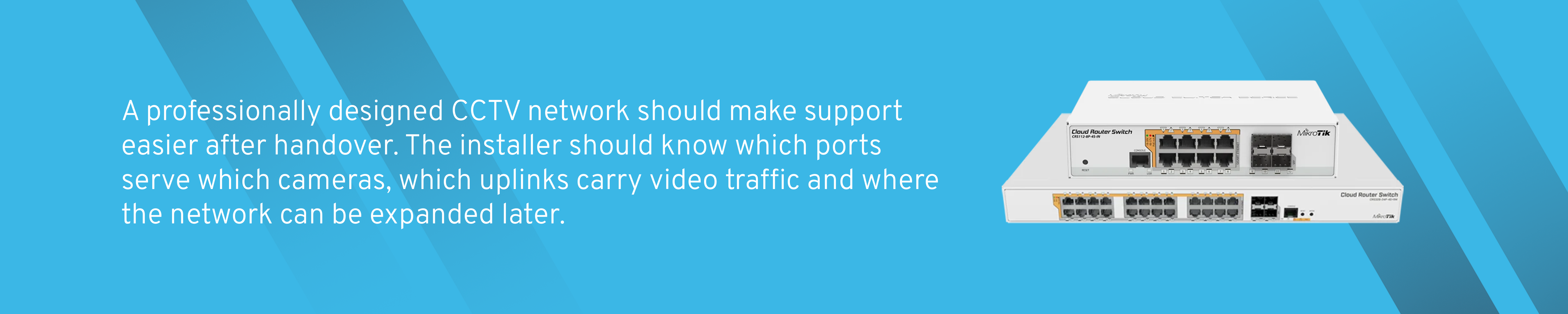
For small CCTV deployments, the MikroTik CRS112-8P-4S-IN is a practical fit. It gives installers eight Gigabit Ethernet ports with PoE-out and four SFP ports for fiber uplink options. That makes it useful for small offices, remote security points, small estates, retail sites, schools, warehouses and edge camera clusters where a compact PoE switch is enough.
For larger CCTV projects, the MikroTik CRS328-24P-4S+RM steps into a more serious role. With 24 Gigabit PoE-out ports, four 10G SFP+ ports and a 1U rackmount form factor, it is better suited to control rooms, larger buildings, bigger camera networks and sites where multiple camera feeds need a stronger switching foundation.
The point is not just to power cameras, but also build CCTV networks that remain stable after installation.
Small Camera Sites Need Discipline Too
Not every CCTV deployment is a mall, campus or industrial facility. Many projects begin with a smaller requirement: a gate, a reception area, a server room, a small office, a branch site, a perimeter point or a remote building.
These smaller sites still deserve proper network design.
The MikroTik CRS112-8P-4S-IN fits that space well because it gives installers a compact managed PoE switching platform with fiber uplink flexibility. For CCTV work, that combination is useful. Cameras may sit in one part of a facility, while the recorder, server room or main network is somewhere else. The SFP ports give installers the option to plan cleaner uplinks instead of stretching copper beyond where it makes sense.
It is also important to specify power correctly. The CRS112 can support different PoE output options, but installers should match the input power and camera requirements carefully, especially where 802.3af/at devices are involved. That kind of detail matters in CCTV. A camera that powers inconsistently is not a small inconvenience. It is a blind spot.
For small CCTV projects, the CRS112 is best understood as a disciplined edge switch. It keeps camera power and connectivity organized without forcing the client into a larger rackmount switch before the project needs it.
Larger CCTV Projects Need More Than Port Count

As CCTV projects grow, the switch selection becomes more strategic.
A 24-camera installation is not simply three times larger than an eight-camera installation. It creates more traffic, more cabling, more power demand, more troubleshooting points and more pressure on the uplink to the control room or core network.
Here, the MikroTik CRS328-24P-4S+RM becomes a strong fit.
Its 24 Gigabit PoE-out ports allow security integrators to consolidate camera connections in a rackmount switch. The built-in high-capacity power supply gives the deployment a more serious PoE foundation. The four 10G SFP+ ports are especially useful where the CCTV network needs higher-speed uplinks to storage, a core switch, a control room, or another building.
This matters because modern cameras are not getting lighter on the network. Higher resolutions, more cameras and longer retention expectations all increase pressure on the infrastructure. A switch that only looks adequate on port count may become weak once traffic, uplink capacity and power planning are considered together.
The CRS328 gives larger CCTV projects room to breathe.
Control Rooms Depend on Clean Network Design
A control room is where the entire CCTV network is truly judged.
If feeds lag, cameras drop, playback stalls or operators struggle to access footage, the client rarely blames the switch by name. They blame the whole system.
That is why control room networks need cleaner design from the start.
For smaller control points, a MikroTik CRS112-8P-4S-IN can support compact camera clusters or remote camera zones feeding back to the main monitoring location. For larger control rooms, the CRS328 provides a more suitable rackmount switching layer, especially where many cameras terminate in one location and uplink capacity matters.
The benefit of MikroTik in this environment is control. Installers can design around managed switching instead of treating the network as a passive cable collector. VLANs, port organization, uplink planning and monitoring become easier to structure when the switch is part of the design conversation from the beginning.
A professionally designed CCTV network should make support easier after handover. The installer should know which ports serve which cameras, which uplinks carry video traffic and where the network can be expanded later.
That is the difference between a camera installation and a surveillance infrastructure project.
Fiber Uplinks Improve CCTV Network Performance
Many CCTV sites are physically spread out.
A warehouse may have cameras across loading bays, offices, gates and perimeter walls. An estate may need cameras at entrances, blocks and common areas. A school may need surveillance across classrooms, administration buildings, hostels and outdoor areas. A commercial property may have multiple floors or separate buildings.
In these environments, fiber uplinks are often the cleanest way to connect camera zones back to the control room or core network.
The CRS112 provides four SFP ports for Gigabit fiber uplinks, making it useful for smaller camera zones and edge locations. The CRS328 provides four SFP+ ports for higher-capacity uplinks, making it more suitable when larger camera groups need to send traffic back to storage or monitoring systems.
This makes MikroTik PoE switches become particularly useful for security integrators. They allow camera power, local switching and uplink planning to sit in one practical design reducing clutter and improving supportability, giving the project a better foundation for growth.
Better CCTV Projects Are Easier to Support
Security integrators do not only sell installation, but also support.
That support becomes difficult when the network is poorly structured. Unknown cabling, unmanaged switches, overloaded uplinks and undocumented camera ports can turn basic troubleshooting into site archaeology.
A managed PoE switching approach helps reduce that problem. With the CRS112, an installer can bring order to smaller camera zones. With the CRS328, larger installations can be organized around a rackmount switch that supports more cameras, stronger uplinks and better long-term management.
This matters commercially. A clean deployment protects the installer’s reputation. It also gives the client more confidence that the CCTV system can be maintained, expanded and supported over time.
The best security projects are not the ones that only look good on commissioning day. They are the ones that remain understandable six months later.
Choosing the Right MikroTik PoE Switch for Your CCTV Project
The MikroTik CRS112-8P-4S-IN is the better fit where the CCTV requirement is smaller, distributed or edge-based. It is useful for compact deployments, remote camera zones, branch sites, small offices, gatehouses, retail sites and local camera clusters that need PoE switching with fiber uplink options.
The CRS328-24P-4S+RM is the better fit where the project has more cameras, a rack environment, a control room, higher uplink requirements or a need for more structured expansion. It is useful for larger offices, estates, warehouses, schools, hospitals, malls, industrial sites and other projects where camera density and reliability matter.
Both products serve the same larger purpose: building CCTV networks that are easier to power, easier to connect and easier to support.
The choice depends on the site. Small camera cluster? CRS112.
Larger control room or camera concentration point? CRS328.
Distributed site with fiber links between buildings? Use the model that fits the camera count, uplink demand and power requirement at each location. That is the kind of matching that prevents expensive mistakes.
Build CCTV Networks That Stay Online with Optace Networks
If cameras are part of site security, operations, compliance or incident response, the switching layer must be taken seriously. Power must be stable. Uplinks must be planned. Camera zones must be organized. The control room must receive traffic reliably.
MikroTik gives installers practical PoE switching options for that work.
As a Master Distributor/Value Added Distributor of MikroTik, Optace Networks supplies MikroTik PoE switches and related networking solutions for security integrators, installers, resellers and organizations building reliable surveillance infrastructure.
We help match the switch to the site requirement, whether the project needs a compact PoE switch for a small camera zone or a rackmount PoE switch for a larger control room environment.
The aim is simple: help installers build CCTV networks that work cleanly, scale sensibly and remain supportable after handover.

Latest Articles
Thu Jul 23 2026
MikroTik CRS354-48P-4S+2Q+RM for Hotels and Campuses: Reliable Connectivity Without Overbuilding.Tue Jun 23 2026
MikroTik for CCTV Networks: Reliable PoE Switching for Cameras, Control Rooms and Security Projects.Mon Jun 15 2026
Cambium cnPilot e510: Outdoor Wi-Fi Value Beyond Unit PriceRelated Articles
.jpg)
ePMP 3000 - 5X Performance with Gen3 Technology
-(1).png)
Africa Tech Festival Displays Strides in Connectivity and Telecommunications Infrastructure across Africa

Cambium Networks ePMP Force 425 - The Industry’s First Point-to-Point Solution Based on 802.11ax
The Power of OFDMA in Wireless Broadband
In this article, we delve into the principles of OFDMA, the defining principle of the 802.11ax standard, its applications, and its impact on wireless broadband.



© 2026 PoweredbyOptace Networks Limited. All Rights Reserved.