
Business network upgrades are rarely triggered by a complete failure of connectivity. They usually begin when the existing environment becomes difficult to control.
New switches have been added over time. Branches run different routers. Firewall rules are poorly documented. Uplinks are approaching capacity and troubleshooting depends heavily on whoever installed the network.
At that point, the priority is no longer adding another device. The business needs a defined managed network infrastructure model that can support growth without increasing operational complexity.
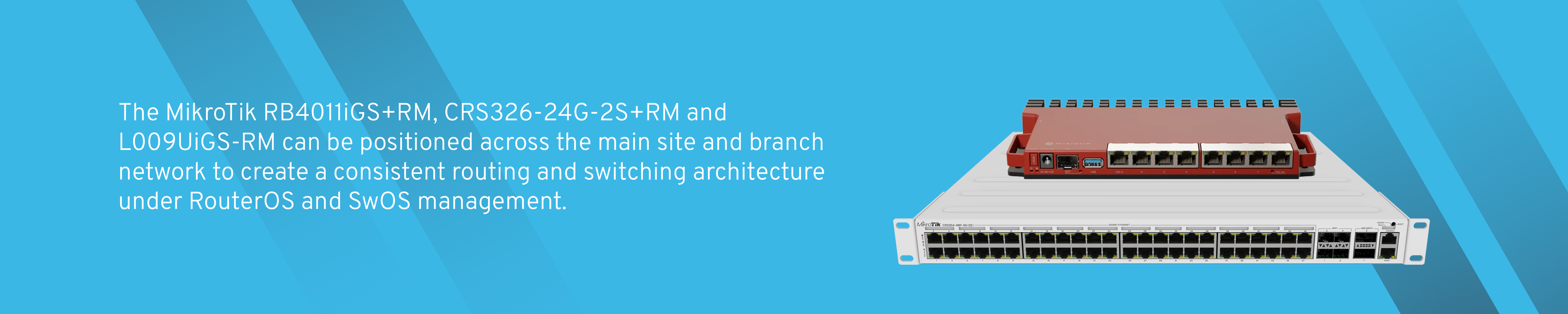
MikroTik provides a practical platform for this transition. The Mikrotik RB4011iGS+RM, CRS326-24G-2S+RM and L009UiGS-RM can be positioned across the main site and branch network to create a consistent routing and switching architecture under RouterOS and SwOS management.
Upgrade the Architecture, Not Individual Devices
Replacing an ageing router or unmanaged switch may solve an immediate constraint, but the larger value comes from assigning each device a deliberate role within the network.
The main-site router should operate as the policy and connectivity boundary. It controls WAN access, routing between network segments, branch tunnels, remote access, site-to-site VPN tunnels, VLAN routing and traffic policies.
The access switch should provide a structured connection point for office users and infrastructure devices. Its uplinks should also leave enough capacity for server traffic, storage access and future aggregation requirements.
Branch routers should follow the same operating model as the head office, even where the hardware footprint is smaller. This creates consistency in addressing, firewall configuration, VPN deployment and remote support.
The objective is a network that can be administered as one environment rather than a collection of unrelated installations.
RB4011iGS+RM: Main-Site Routing and Policy Control
The Mikrotik RB4011iGS+RM is well suited to the central routing role in a growing SME, head office or high-activity branch.
Its combination of Gigabit Ethernet interfaces and a 10G SFP+ interface allows it to sit between the WAN, the switching layer and internal network segments without immediately becoming an uplink constraint.
This makes it suitable for environments where the router is expected to handle more than internet breakout. It can manage site-to-site VPN connectivity, remote-user access and routing between internal networks while enforcing firewall policies at a central point.
For technical teams, the RB4011 provides greater control over how traffic moves through the business. Access between departments and systems can be defined according to operational requirements, while bandwidth policies can protect critical services during periods of high utilization.
For decision-makers, the benefit is infrastructure headroom. The organisation can add users, introduce additional segments or connect new branches without replacing the core router each time the network changes.
CRS326-24G-2S+RM: A Controlled Access Layer
The Mikrotik CRS326-24G-2S+RM provides the switching foundation for a structured office LAN. Its 24 Gigabit Ethernet ports can support end-user connections and local infrastructure, while the two SFP+ interfaces provide 10G uplink options to the router, servers, or an upstream aggregation layer.
The SFP+ interfaces are particularly important in an upgrade scenario. A business may still operate predominantly at Gigabit speeds at the desk while requiring more capacity between the switch and shared infrastructure.
From an operational perspective, the CRS326 allows the technical team to move away from unmanaged switching. Port configuration, traffic separation, and link monitoring become part of the network design rather than informal workarounds introduced after deployment.
This improves fault isolation. When a device loses connectivity or a link begins behaving abnormally, the support team has a defined switching layer to inspect instead of tracing cables through several unmanaged devices.
The CRS326 is therefore best positioned as an access switch for offices, branches and small server-room environments where visibility and uplink capacity matter more than simply increasing the number of available ports.
L009UiGS-RM: Standardised Routing for Smaller Sites
The L009UiGS-RM extends the same management approach to smaller branches and dedicated network zones.
Its rackmount form factor makes it suitable for compact cabinets and structured branch installations. It can operate as the main edge router for a smaller site or support an isolated operational area within a larger facility.
The main advantage is consistency.
A business can use the RB4011 at its primary location and deploy the L009UiGS-RM across smaller sites while retaining a familiar RouterOS environment. Technical teams can standardise configuration templates, firewall conventions and VPN settings across the organisation.
This reduces deployment variation between branches. New locations can be commissioned using an established design, and support teams can work from a known configuration model when investigating faults remotely.
For businesses expanding into additional offices, retail locations or service centres, this consistency is often more valuable than deploying more powerful hardware than the site requires.
_1785846021.png)
A Practical Deployment Model
A typical deployment could position the RB4011iGS+RM at the head office as the internet edge and central routing platform.
The CRS326-24G-2S+RM would provide the managed access layer, with its SFP+ interfaces used for higher-capacity connections to the router or shared infrastructure.
Smaller branches would use the L009UiGS-RM to establish secure connectivity back to the main site and apply the organisation’s standard network policies locally.
Within this model, segmentation is implemented according to business function rather than added as a separate feature. User networks, guest access and operational systems can be placed into defined zones, with access between them controlled at the routing layer.
Configuration backups, device naming and change records should also follow a common standard. This gives the business an infrastructure model that remains supportable as more sites and services are introduced.
The Operational Value of a Managed Foundation
The strongest case for a managed network upgrade is operational control.
A structured environment reduces the time spent tracing undocumented connections and interpreting inconsistent router configurations. It allows changes to be made deliberately and gives the technical team a clearer view of how each part of the network supports the business.
It also improves expansion planning. New departments, branches and systems can be introduced within an existing architecture instead of requiring separate network designs each time.
For management, this means fewer infrastructure surprises and a clearer relationship between network investment and business growth.
For technical personnel, it creates a platform that can be monitored, documented and maintained with greater discipline.
Build the Network Around the Business
The Mikrotik RB4011iGS+RM, CRS326-24G-2S+RM and L009UiGS-RM fit different positions within the same upgrade strategy.
The RB4011 provides main-site routing and policy control. The CRS326 establishes a managed switching layer with 10G uplink capability. The L009UiGS-RM extends a consistent RouterOS operating model to smaller sites.
Together, they give growing businesses a practical path from fragmented connectivity to a network architecture that is easier to manage and expand.
At Optace Networks, we help businesses, installers and resellers design MikroTik infrastructure around real site requirements. We assess user density, uplink capacity, branch connectivity and operational constraints before specifying the hardware.
Talk to Optace Networks about building a MikroTik network foundation that supports your current environment and the next stage of business growth.
Latest Articles
Fri Sep 18 2026
How to Size a Netgate Firewall for Your Business NetworkWed Sep 09 2026
Planning Internet Failover with Netgate and pfSense PlusFri Aug 28 2026
Fuzion FTP-300 for Outdoor IoT and Surveillance NetworksRelated Articles
.jpg)
ePMP 3000 - 5X Performance with Gen3 Technology
-(1).png)
Africa Tech Festival Displays Strides in Connectivity and Telecommunications Infrastructure across Africa

Cambium Networks ePMP Force 425 - The Industry’s First Point-to-Point Solution Based on 802.11ax
The Power of OFDMA in Wireless Broadband
In this article, we delve into the principles of OFDMA, the defining principle of the 802.11ax standard, its applications, and its impact on wireless broadband.



© 2026 PoweredbyOptace Networks Limited. All Rights Reserved.