
A hotel network carries the guest experience. A campus network carries daily operations.
Once a facility has dozens of WI-FI access points, CCTV cameras, VoIP phones, control devices, and users moving across different spaces, the access layer becomes one of the most important parts of the network. It decides how cleanly endpoints are powered, how traffic moves upstream, and how easily the technical team can support the site after installation.
The MikroTik CRS354-48P-4S+2Q+RM PoE switch is built for that layer.
It brings 48 Gigabit Ethernet PoE-out ports, 4 x 10G SFP+ ports and 2 x 40G QSFP+ ports into one rackmount switch. For hotels, campuses, hostels, schools, hospitals, office parks and multi-user facilities, that makes it a strong choice where endpoint density, PoE planning and uplink capacity all matter.
Indulge us as we explore how the CRS354 fits projects where the client wants a more serious access network without turning every upgrade into a full enterprise refresh.
The Access Layer Carries the Real Load
In hotels and campuses, the network pressure usually gathers around endpoints.
Access points need power and clean uplinks. CCTV cameras need stable PoE and predictable traffic paths. IP phones, access control terminals, signage, and other connected systems need ports that are easy to identify and manage.
As these endpoints grow, small switches scattered across racks and corners start creating support problems. The site may still work, but troubleshooting becomes slower, documentation gets weaker, and expansion becomes more improvised.
The MikroTik CRS354-48P-4S+2Q+RM gives network integrators and managed service providers (MSPs) a cleaner way to build that access layer.
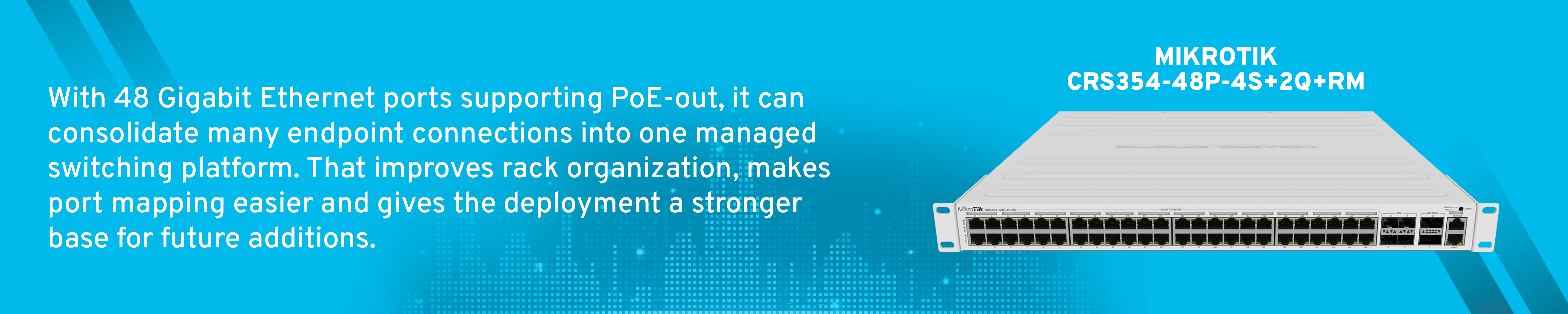
With 48 Gigabit Ethernet ports supporting PoE-out, it can consolidate many endpoint connections into one managed switching platform. That improves rack organization, makes port mapping easier and gives the deployment a stronger base for future additions.
For a hotel, that may mean access points across rooms, corridors, restaurants, lobbies and conference areas. For a campus, this may include classrooms, hostels, labs, libraries, administration blocks, and security zones.
The value is simple: bring endpoint density under control.
Built for Wi-Fi, CCTV and Facility Devices
Modern facility networks are multi-service environments.
The same access layer may carry guest Wi-Fi, staff connectivity, CCTV, VoIP, access control and building systems. Each service may have different traffic patterns, support requirements and priority levels.
The CRS354 gives integrators enough switching density to design around that reality.
Its PoE-out capability across all 48 Gigabit Ethernet ports makes it useful for powering compatible wireless access points, cameras and other networked devices. Its support for multiple PoE output options gives installers flexibility when working with mixed endpoint requirements, provided the PoE budget and device specifications are planned properly.
This is especially relevant in facilities where access points and cameras are being added in phases.
A hotel may start with guest Wi-Fi improvements, then add more CCTV coverage, then expand conference connectivity. A campus may upgrade classrooms first, then hostels, then security zones. The CRS354 gives these projects a more organized platform for phased growth.
10G and 40G Uplink Headroom for High-Capacity Sites
A dense access switch needs enough upstream capacity to make the design worthwhile.
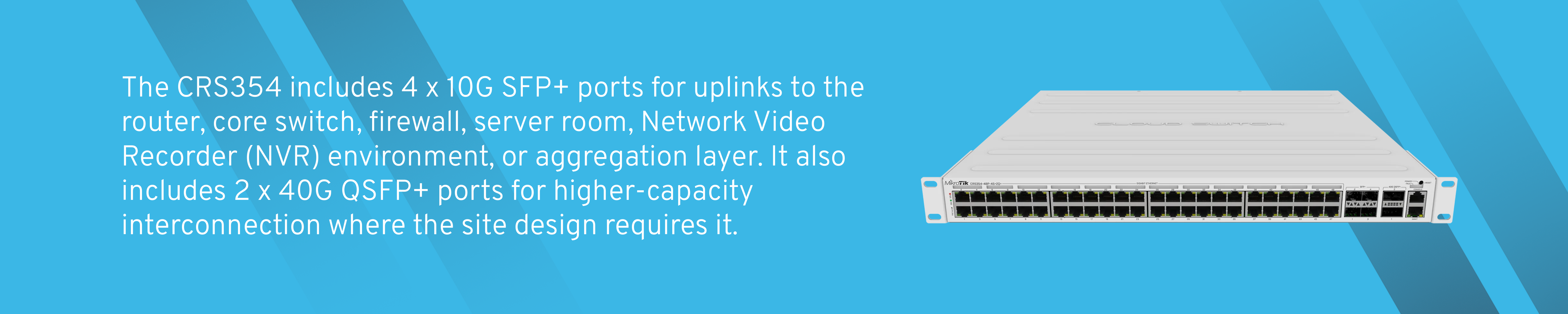
The CRS354 includes 4 x 10G SFP+ ports for uplinks to the router, core switch, firewall, server room, Network Video Recorder (NVR) environment, or aggregation layer. It also includes 2 x 40G QSFP+ ports for higher-capacity interconnection where the site design requires it.
That uplink mix gives hotels and campuses more room to plan.
A property can use the Gigabit ports for endpoint access, 10G ports for uplinks, and 40G ports for backbone or switch-to-switch links in larger designs. This allows the network to grow in stages while keeping the access layer useful beyond the first phase of deployment.
That matters in facilities where the original endpoint count rarely stays fixed.
Why the CRS354 Makes Sense for Hotels
Hotels judge network quality through experience.
Guests expect fast and reliable Wi-Fi in rooms and public areas. Conference clients expect stable connectivity when the room is full. Staff need booking systems, payment terminals, back-office tools, and phones to remain available. Security teams need camera feeds that stay live.
The CRS354 supports this mix well by providing the hotel with a single high-density PoE platform for many access-layer needs.
It can support access points across guest-facing areas, cameras in security zones, phones in staff areas, and other connected systems from a cleaner rack environment. The 10G uplinks help move traffic upstream properly, while the 40G ports give the design extra backbone options where the network is larger or more demanding.
For hotels upgrading from scattered switches or limited PoE capacity, the CRS354 offers a more deliberate way to organize the access layer while improving network reliability, simplified cable management and future scalability.
Why the CRS354 Makes Sense for Campuses
Campuses reward consistency.
A school, university, hospital, or institutional campus may have several network zones with different usage patterns. Classrooms carry learning traffic. Hostels carry student devices. Libraries and labs may need stable wired and wireless access. Security zones carry camera traffic. Administration blocks carry business systems and phones.
The MikroTik CRS354-48P-4S+2Q+RM PoE switch can serve as a repeatable access switch across those zones.
It gives each building, floor, block, or network area a strong PoE switching platform with enough uplink flexibility to connect back to aggregation or core infrastructure. For integrators, that creates a more consistent deployment model across the campus.
Consistency helps with installation, spares, documentation, and assists the support team in understanding the network faster when something needs attention. For campuses planning long-term growth, that consistency is valuable.
Right-Sized Growth Beats Patchwork Expansion
Many hotel and campus networks grow through additions.
A switch is added for cameras. Another one pops up for access points. Another supports a new wing. Another handles a temporary requirement that becomes permanent. Over time, the network keeps running, but the design becomes harder to explain.
The MikroTik CRS354-48P-4S+2Q+RM helps bring that growth into a more controlled structure.
Its 48 Gigabit Ethernet PoE-capable ports allow a large number of endpoints to sit on one managed switch. Its 10G and 40G uplink options give the design more room upstream. Its rackmount format fits professional network rooms where cabling, power and documentation need to be kept clean.
For some properties, one CRS354 can anchor a major access layer. For larger facilities, multiple CRS354 switches can be deployed across buildings, floors or zones. Either way, the site gains a more consistent foundation than a collection of small switches added as problems appear.
This is the kind of infrastructure choice that keeps growth practical.
_1784802216.png)
Build Reliable Access Around the Right Switching Layer
The MikroTik CRS354-48P-4S+2Q+RM is strongest where endpoint density, PoE demand and uplink growth meet.
That is the real conversation for hotels, campuses, hostels, schools, hospitals, office parks and multi-user facilities.
Before selecting an access switch, organizations should make considerations such as:
- How many wireless access points will serve the site?
- How many cameras need stable PoE?
- Which systems depend on the same access layer?
- Where does traffic move upstream?
- Is the switch serving a floor, a rack, a building or a wider campus zone?
- How much room should the network leave for 10G uplinks today and higher-capacity backbone planning later?
Those questions turn switching from a port-count decision into a proper infrastructure decision.
The MikroTik CRS354-48P-4S+2Q+RM brings together the features that matter in dense facility networks: 48 Gigabit PoE-out ports for access points, CCTV cameras and powered endpoints; 10G SFP+ ports for practical uplinks; and 40G QSFP+ ports for higher-capacity interconnection where the design requires it.
At Optace Networks, we supply MikroTik switching solutions for integrators, resellers and organizations building reliable facility networks. For projects where access-layer density, PoE planning and uplink headroom matter, we help position the CRS354 in the right role.
Talk to us for MikroTik switching solutions built around reliable access, practical PoE design and scalable hotel and campus connectivity.
Latest Articles
Wed Sep 09 2026
Planning Internet Failover with Netgate and pfSense PlusFri Aug 28 2026
Fuzion FTP-300 for Outdoor IoT and Surveillance NetworksRelated Articles
.jpg)
ePMP 3000 - 5X Performance with Gen3 Technology
-(1).png)
Africa Tech Festival Displays Strides in Connectivity and Telecommunications Infrastructure across Africa

Cambium Networks ePMP Force 425 - The Industry’s First Point-to-Point Solution Based on 802.11ax
The Power of OFDMA in Wireless Broadband
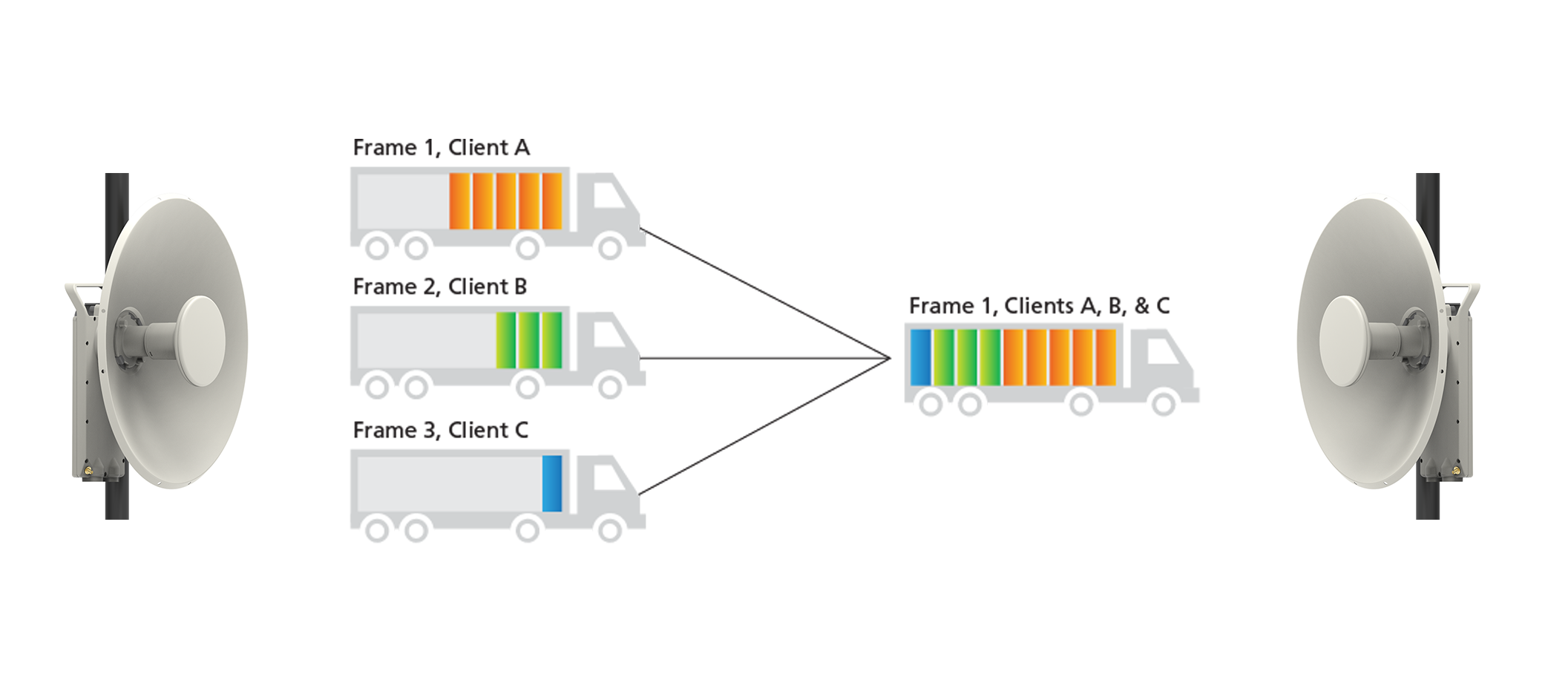
In this article, we delve into the principles of OFDMA, the defining principle of the 802.11ax standard, its applications, and its impact on wireless broadband.



© 2026 PoweredbyOptace Networks Limited. All Rights Reserved.