
For businesses investing in faster servers, storage and network infrastructure, 100 Gigabit Ethernet (100G) networking is becoming an increasingly relevant consideration. The challenge has often been justifying the cost of upgrading the network to support that level of connectivity.
MikroTik is making that decision more interesting.
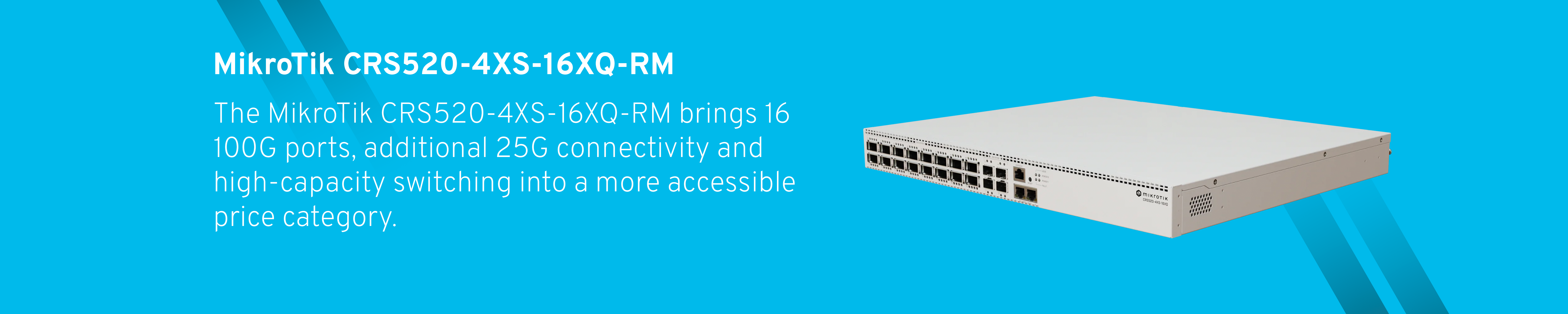
Following its push into high-performance storage and networking with the ROSE Data Server, MikroTik's CRS520-4XS-16XQ-RM brings a similarly ambitious proposition to enterprise switching: 16 ports of 100G connectivity in a single device, offered at a price point that challenges conventional expectations of high-capacity networking equipment.
MikroTik positions the CRS520 as delivering one of the most competitive costs per 100G port in the market. For organizations that have previously considered high-density 100G switching prohibitively expensive, the CRS520 presents a compelling reason to reconsider.
More Bandwidth Without Overhauling the Entire Network
Moving to 100G does not necessarily mean replacing every switch or upgrading every server connection.
Many enterprise networks already operate successfully with 10G or 25G connections at the server level. The greater challenge arises when traffic from multiple servers or network segments converges on uplinks that no longer have sufficient capacity.
A 100G aggregation network can address that limitation while allowing much of the existing infrastructure to remain in service.
The CRS520 provides 16 × 100G QSFP28 ports, complemented by four 25G SFP28 ports and two 10GbE copper connections. This allows organizations to introduce higher-speed connectivity where it is needed while accommodating equipment operating at lower speeds.
For a data centre, that might mean connecting several racks of servers to a high-capacity backbone. An internet service provider could use the same switch to aggregate traffic from multiple network segments or connect high-capacity routing infrastructure.
The commercial advantage is that businesses can direct their investment towards the parts of the network where additional capacity will make the greatest difference.
There's More to the CRS520 Than Affordable 100G Ports
MikroTik has equipped the CRS520 with capabilities that extend its role beyond conventional Layer 2 switching, making it a high-capacity managed switch for enterprise networking and data centre infrastructure.
Its Marvell switching chipset provides up to 3.4 Tbps of full-duplex switching capacity, while a quad-core 2 GHz ARM processor and 4 GB of RAM support more advanced network operations through RouterOS v7.
The CRS520 supports dynamic routing protocols, including BGP and OSPF, and can perform supported Layer 3 routing operations directly through its switching hardware.
For infrastructure teams, this creates opportunities to handle high-speed switching and certain routing functions on the same platform, potentially reducing the need for additional equipment. The suitability of that approach depends on the network architecture and the functions that can be hardware-accelerated.
The switch also includes dual hot-swappable power supplies and replaceable cooling fans, features that simplify maintenance in environments where network availability matters, like in data centres and other high demand network environments.
MikroTik's approach to software licensing adds another commercial advantage. RouterOS comes preinstalled and licensed, with no recurring subscription required to continue using the operating system.
For organizations assessing the long-term cost of network infrastructure, avoiding recurring software licensing charges can be just as relevant as negotiating a competitive hardware purchase price.

Making the Business Case for 100G Networking
The CRS520 makes high-capacity switching more accessible, but a lower hardware price alone does not justify a network upgrade.
Organizations still need to consider whether their traffic requirements warrant 100G connectivity, how the switch will integrate with existing infrastructure, and what additional equipment will be required.
Optical transceivers, suitable network interfaces and cabling all contribute to the final deployment cost. Network design requirements, particularly around redundancy, must also be considered.
However, the CRS520 changes an important part of the investment equation.
By bringing high-density 100G switching into a more accessible price category, MikroTik is giving businesses greater flexibility in how they plan infrastructure upgrades. Projects that may previously have been difficult to justify on hardware costs alone become more viable for evaluation.
For data centres expanding their compute infrastructure or ISPs preparing for higher traffic volumes, the opportunity is to increase network capacity while keeping capital expenditure under control.
The MikroTik CRS520 demonstrates that organizations no longer have to associate high-capacity enterprise switching with disproportionately high equipment costs.
It won't make 100G necessary for every organization, but it makes the technology considerably harder to ignore when the next infrastructure upgrade comes around.
For businesses considering a 100G network upgrade or evaluating high-capacity switching solutions, Optace Networks can provide a competitive quotation for the MikroTik CRS520, helping you assess the investment against your network requirements.
Latest Articles
Thu Oct 29 2026
MikroTik Is Making 100G Networking Harder to IgnoreWed Oct 14 2026
Netgate 8300 for High-Capacity Firewall and VPN DeploymentsFri Sep 18 2026
How to Size a Netgate Firewall for Your Business NetworkWed Sep 09 2026
Planning Internet Failover with Netgate and pfSense PlusFri Aug 28 2026
Fuzion FTP-300 for Outdoor IoT and Surveillance NetworksRelated Articles

ePMP 3000 - 5X Performance with Gen3 Technology

Africa Tech Festival Displays Strides in Connectivity and Telecommunications Infrastructure across Africa

Cambium Networks ePMP Force 425 - The Industry’s First Point-to-Point Solution Based on 802.11ax
The Power of OFDMA in Wireless Broadband
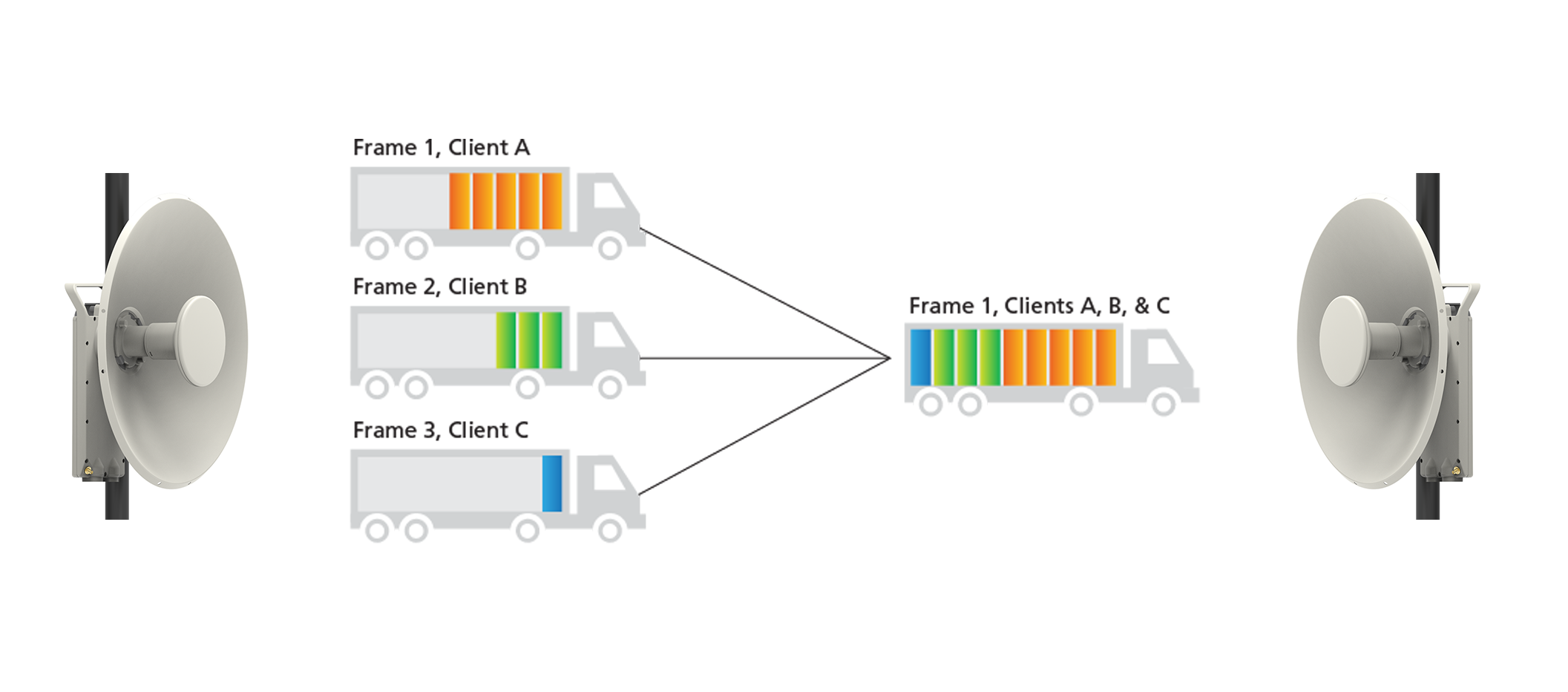
In this article, we delve into the principles of OFDMA, the defining principle of the 802.11ax standard, its applications, and its impact on wireless broadband.



© 2026 PoweredbyOptace Networks Limited. All Rights Reserved.